Managing token consumption in large language models has evolved from a basic developer curiosity into an essential software engineering discipline. In 2026, with the arrival of Anthropic's flagship Claude 3.7 Sonnet, the high-throughput Claude 3.5 Haiku, and the analytical Claude 3 Opus, understanding how tokens are calculated is the difference between an efficient, profitable AI application and a runaway cloud invoice.
Whether you are building complex Retrieval-Augmented Generation (RAG) architectures, multi-agent automated coding assistants, autonomous customer support pipelines, or long-document legal analyzers, tokens govern three fundamental constraints: API billing costs, context window capacity, and model response latency.
In this comprehensive guide on how to count claude tokens, we explore how an accurate AI token counter transforms your LLM workflow. We unpack the mathematical mechanics of Claude tokenization, explain why word-to-token conversions fail when handling code or structured data, analyze Claude 3.7 Sonnet's 200,000-token context window with extended thinking budgets, and provide an actionable blueprint for slashing API costs by up to 90% using Prompt Caching and Batch API workflows.
Pro Tip
Need an instant token count and cost estimate for your prompt? Open our Free Claude Token Counter & Context Calculator. Functioning as both a dedicated Claude 3.7 Sonnet token counter and an Anthropic context window calculator(https://rajatupadhyay.in/tools/claude-token-counter/) to inspect exact tokens, context headroom, and pricing across Claude 3.7 Sonnet, 3.5 Haiku, and Opus in USD and INR.
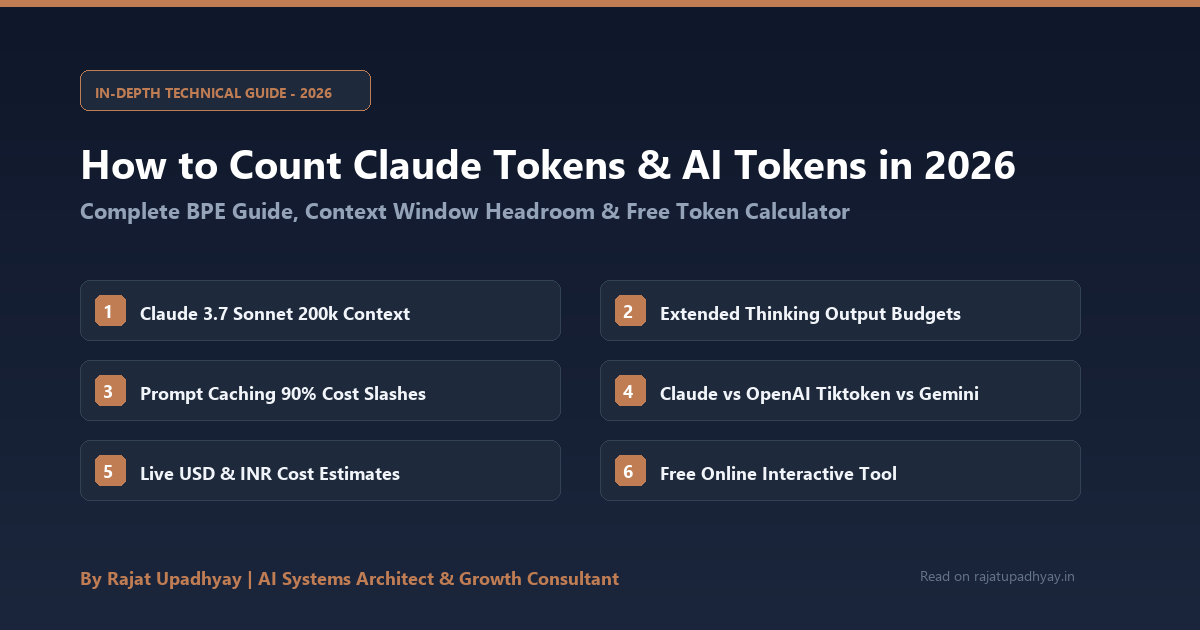
How to Count Claude Tokens and AI Tokens Guide 2026
---
1. Why Token Counting is Crucial in 2026 for Claude 3.7 Sonnet, 3.5 Haiku & Opus (The AI Token Counter Imperative) for Claude 3.7 Sonnet, 3.5 Haiku & Opus
When deploying large language models in enterprise production, a reliable AI token counter is no longer an optional utility: it is a mission-critical infrastructure tool. Artificial intelligence models do not read human text as letters, sentences, or paragraphs. Instead, they ingest sequences of integers known as tokens. Every character, word piece, punctuation mark, and whitespace sequence is mapped to a discrete numeric ID in the model's vocabulary table.
In 2026, token management is more critical than ever due to four major industry shifts:
The Emergence of Hybrid Reasoning & Extended Thinking
With Claude 3.7 Sonnet, Anthropic introduced hybrid reasoning capabilities where the model can alternate between rapid standard responses and extended thinking modes. In extended thinking mode, Claude can generate up to 64,000 tokens of internal chain-of-thought reasoning before outputting its final response. If your initial prompt occupies 170,000 tokens of the 200,000 token limit, your extended thinking headroom drops to 30,000 tokens, risking abrupt output truncation mid-computation.
Asymmetric Input vs Output Cost Structures
Across modern LLM providers, output tokens cost between 3x and 5x more than input tokens. On Claude 3.7 Sonnet, input tokens cost $3.00 per million tokens (MTok), whereas output tokens cost $15.00 per MTok. In Claude 3 Opus, input tokens cost $15.00 per MTok while output tokens surge to $75.00 per MTok. Failing to monitor and estimate prompt length before dispatching recursive or agentic loops can multiply production expenses tenfold.
High-Volume Agentic Loops & Context Compounding
Autonomous AI agents, such as software development bots and market research tools, continuously append tool call results, bash terminal logs, and system error traces into ongoing chat histories. Without an active client-side token counter or pruning filter, an agent conversation quickly spirals from 2,000 tokens to 80,000 tokens within ten turns, triggering severe billing spikes on repeated input processing.
Dynamic Prompt Caching Opportunities
Anthropic allows developers to cache prompt prefixes for up to 5 minutes at an incredible 90% discount ($0.30 per MTok read vs $3.00 per MTok standard input on Claude 3.7 Sonnet). However, Prompt Caching requires a minimum prompt threshold (typically 1,024 tokens for Sonnet and 2,048 tokens for Haiku). If you do not count tokens accurately before making API requests, you will miss the caching threshold, forfeiting massive cost reductions.
---
2. How Claude Tokenization Works: Byte-Pair Encoding (BPE) & Word-to-Token Ratios
To master how to count claude tokens accurately across production pipelines, you must understand the underlying algorithm Anthropic employs: Byte-Pair Encoding (BPE). Using an online AI token counter calibrated specifically for Anthropic models prevents estimation errors caused by generic word count multipliers.
The Byte-Pair Encoding (BPE) Mechanism
Byte-Pair Encoding is a sub-word compression algorithm that builds a vocabulary from frequent character pairs. Rather than assigning a unique token to every possible English word (which would require a dictionary of millions of entries) or tokenizing letter-by-letter (which would create prohibitively long sequences), BPE strikes a mathematical balance:
- Base Vocabulary: The tokenizer starts with basic byte characters (ASCII, UTF-8 byte representations, spaces, and punctuation).
- Frequency Merging: The tokenizer analyzes billions of lines of diverse text and code, identifying the most frequent adjacent character pairs and merging them into new tokens. For example, 't' and 'h' merge to form 'th', which then merges with 'e' to form 'the '.
- Sub-Word Flexibility: Common words like 'calculate' or 'algorithm' exist as single tokens. Rare, compound, or foreign words are split into clean morphological sub-words (e.g., 'token' + 'ization').
- Whitespace Sensitivity: Spaces in front of words are incorporated directly into the token. ' Apple' (with a leading space) is treated as an entirely different token ID than 'Apple' (without a leading space).
Raw Sentence: "Token counting in 2026 saves developers thousands of dollars."

BPE Token Decomposition:
[Token] [ count] [ing] [ in] [ 20] [26] [ saves] [ developers] [ thousands] [ of] [ dollars] [.]

Total Tokens: 12 tokens for 9 English words (~1.33 tokens per word)
The Standard Word-to-Token Ratio
On standard English prose, textbooks, customer support tickets, and news articles:
- 1 Token is approximately equal to 0.75 words (or 4 characters).
- 100 Words equate to approximately 133 tokens.
- 1,000 Tokens represent roughly 750 words.
However, relying on a naive "words multiplied by 1.33" heuristic is dangerous in production engineering because token ratios swing dramatically depending on content type.
The Code and Special Character Expansion Penalty
Programming languages, JSON schemas, SQL queries, and mathematical formulas do not follow natural English frequency distributions. As a result, code tokens explode in density:
- Indentation and Whitespace: Every indentation level (2 spaces, 4 spaces, or tabs) consumes discrete tokens unless merged into special multi-space tokens.
- Brackets and Syntax Delimiters: Characters like curly braces \
{\, square brackets \[\, parentheses \()\, semicolons \;\, colons \:\, and backticks \\\` often occupy an entire token per character. - Variable Naming Conventions: CamelCase variables (\
calculateRemainingHeadroom\) or snakecase variables (\calculateremaining_headroom\) break into 3 to 5 separate sub-tokens, whereas standard words are single tokens. - Hexadecimal and Base64 Strings: Hashes, encryption keys, and base64 strings have no natural linguistic sub-words, consuming nearly 1 token for every 2 to 3 characters.
# Code snippet tokenization example
def calculate_cache_savings(input_tokens: int, cache_read_tokens: int) -> float:
    standard_cost = (input_tokens / 1_000_000) * 3.00
    cached_cost = (cache_read_tokens / 1_000_000) * 0.30
    return standard_cost - cached_cost

# Word Count: 28 words
# Claude Token Count: 64 tokens (Ratio: 2.28 tokens per word!)
Notice that for the Python snippet above, the token-to-word ratio surged to 2.28 tokens per word. If you had budgeted using standard English rules, your token projection would be off by more than 70%.
---
3. Claude 3.7 Sonnet 200k Context Window & Extended Thinking Headroom
Anthropic's Claude 3.7 Sonnet and Claude 3.5 Sonnet boast an expansive 200,000-token context window. To put this in perspective, 200,000 tokens represent roughly:
- 150,000 English words
- 500 to 600 book pages
- 12,000 to 15,000 lines of complex software source code
- 80 to 100 complete academic research papers
While 200k tokens offers immense flexibility, managing this buffer requires deliberate architecture, particularly when utilizing Claude 3.7 Sonnet's hybrid reasoning engine.
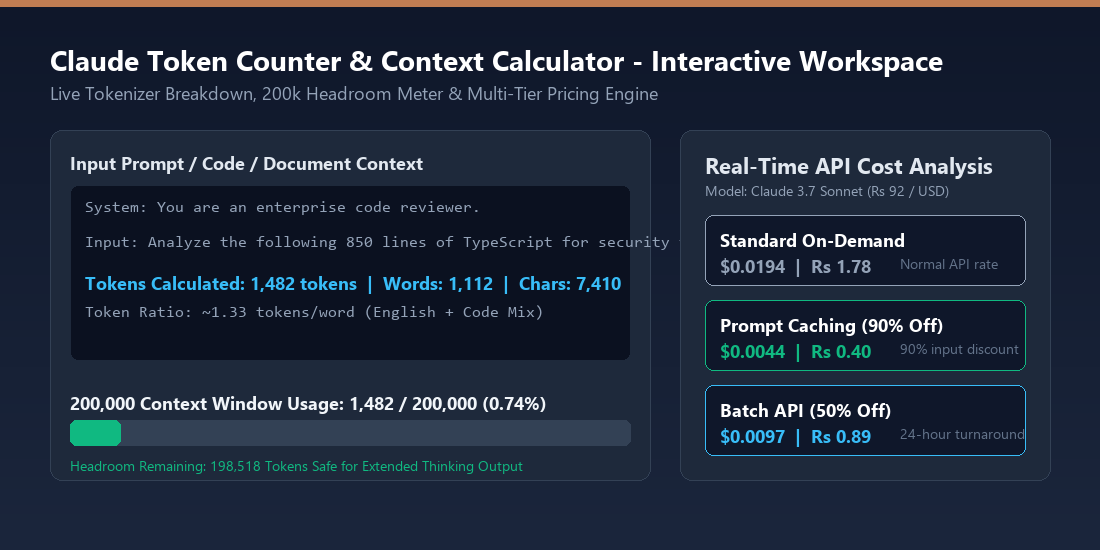
Claude Token Counter Workspace and Headroom Meter
Understanding Total Context Budget Allocation
The 200,000 token limit is a hard combined boundary across both input and output:
$$\text{Total Window (200,000)} = \text{System Prompt} + \text{Document / RAG Context} + \text{Conversation History} + \text{Output Tokens}$$
In standard non-thinking calls, the maximum output token limit is capped at 8,192 tokens. However, in Claude 3.7 Sonnet with extended thinking enabled, the model can generate up to 64,000 output tokens.
The Extended Thinking Headroom Equation and Anthropic Context Window Calculator
When configuring an API request with extended thinking, you must specify a \thinking_budget\. If the sum of your input tokens plus your thinking budget exceeds 200,000, Anthropic's API will return a 400 Bad Request error.
$$\text{Safe Input Headroom} = 200,000 - \text{Max Output Tokens (up to 64,000)} - \text{Safety Buffer (2,000)}$$
This means that if you expect the model to perform deep mathematical derivation or comprehensive architectural synthesis requiring 50,000 reasoning tokens, your prompt input cannot exceed 148,000 tokens.
// Production Context Headroom Checker
export function validateClaudeContextHeadroom(
    inputTokens: number,
    expectedOutputTokens: number,
    isExtendedThinking: boolean = false
): { fits: boolean; remainingHeadroom: number; warning?: string } {
    const MAX_CONTEXT = 200_000;
    const maxOutputLimit = isExtendedThinking ? 64_000 : 8_192;

    const outputTokens = Math.min(expectedOutputTokens, maxOutputLimit);
    const totalProjected = inputTokens + outputTokens;
    const remainingHeadroom = MAX_CONTEXT - totalProjected;

    if (totalProjected > MAX_CONTEXT) {
        return {
            fits: false,
            remainingHeadroom: 0,
            warning: \`Context overflow! Projected \${totalProjected.toLocaleString()} tokens exceeds 200,000 limit by \${Math.abs(remainingHeadroom).toLocaleString()} tokens.\`
        };
    }

    if (remainingHeadroom < 10_000) {
        return {
            fits: true,
            remainingHeadroom,
            warning: "Warning: Less than 10,000 tokens of headroom remain. Long responses risk truncation."
        };
    }

    return {
        fits: true,
        remainingHeadroom
    };
}
Pro Tip
Avoid Context Truncation: Before deploying massive prompts into production, verify your exact context utilization percentage. Our Free Claude Token Counter Tool features a live visual 200,000-token headroom gauge that alerts you when your prompt approaches dangerous capacity limits.
---
4. Cost Optimization Blueprint: Prompt Caching (90% Savings) & Batch API (50% Savings)
Controlling LLM expenditure requires exploiting the economic levers provided by Anthropic's API. The two most powerful mechanisms are Prompt Caching and the Anthropic Batch API.
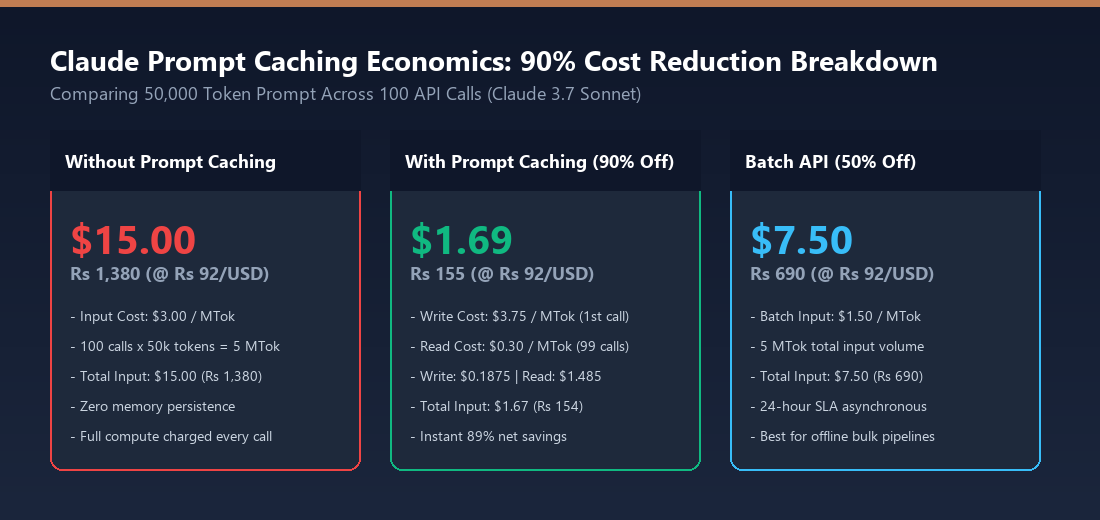
Claude Prompt Caching Economics and Cost Comparison
The Complete Claude Model Pricing Table (2026)
Here is the official pricing structure for Anthropic's primary models, benchmarked in both USD ($ per million tokens) and Indian Rupees (₹ at a standardized conversion rate of ₹92 / USD):
| Model Tier | Standard Input ($ / MTok) | Standard Output ($ / MTok) | Prompt Cache Write ($ / MTok) | Prompt Cache Read ($ / MTok) | Batch Input ($ / MTok) | Batch Output ($ / MTok) |
|---|---|---|---|---|---|---|
| Claude 3.7 Sonnet | $3.00 (₹276) | $15.00 (₹1,380) | $3.75 (₹345) | $0.30 (₹27.60) | $1.50 (₹138) | $7.50 (₹690) |
| Claude 3.5 Sonnet | $3.00 (₹276) | $15.00 (₹1,380) | $3.75 (₹345) | $0.30 (₹27.60) | $1.50 (₹138) | $7.50 (₹690) |
| Claude 3.5 Haiku | $0.80 (₹73.60) | $4.00 (₹368) | $1.00 (₹92) | $0.08 (₹7.36) | $0.40 (₹36.80) | $2.00 (₹184) |
| Claude 3 Opus | $15.00 (₹1,380) | $75.00 (₹6,900) | $18.75 (₹1,725) | $1.50 (₹138) | $7.50 (₹690) | $37.50 (₹3,450) |
How Prompt Caching Cuts Input Costs by 90%
Prompt Caching allows you to store static, high-volume prompt elements (such as comprehensive system guidelines, API documentation, full codebases, or 100-page PDF legal documents) in Anthropic's high-speed memory for 5 minutes.
- Initial Cache Write: The first time the prompt prefix is sent with a cache breakpoint (\
cache_control: {"type": "ephemeral"}\), Anthropic charges a 25% premium ($3.75 / MTok on Sonnet). - Subsequent Cache Reads: Every request sent within the 5-minute time-to-live (TTL) window that matches that exact prefix is processed at a 90% discount ($0.30 / MTok on Sonnet).
- TTL Refresh: Every cache hit automatically refreshes the 5-minute timer, allowing busy production systems to maintain a warm cache indefinitely.
Real-World Dollar & Rupee Example
Consider an AI legal contract review tool that analyzes customer contracts against a standardized 40,000-token corporate compliance policy. The tool handles 200 client queries during a standard working day.
Scenario A: Standard API (No Caching)
- Daily Input Volume: 200 calls x 40,000 tokens = 8,000,000 tokens (8 MTok)
- Cost in USD: 8 MTok x $3.00 = $24.00 per day
- Cost in INR: 24 x ₹92 = ₹2,208 per day
- Monthly Cost (22 business days): $528.00 (₹48,576)
Scenario B: With Prompt Caching Enabled
- Cache Write (1st call): 40,000 tokens x $3.75 / MTok = $0.15 (₹13.80)
- Cache Reads (Remaining 199 calls): 199 calls x 40,000 tokens = 7.96 MTok x $0.30 / MTok = $2.388 (₹219.70)
- Total Daily Cost: $0.15 + $2.388 = $2.538 per day (₹233.50)
- Monthly Cost (22 business days): $55.84 (₹5,137)
Net Result: You save $472.16 (₹43,439) every single month, representing an 89.4% budget reduction!
Slashing Costs by 50% with the Anthropic Batch API
If your workload does not require immediate synchronous responses (for example: nocturnal data extraction, batch catalog enrichment, synthetic dataset generation, or SEO content auditing), the Anthropic Batch API offers an unconditional 50% discount across both input and output tokens:
- Claude 3.7 Sonnet Batch Input: $1.50 / MTok (₹138)
- Claude 3.7 Sonnet Batch Output: $7.50 / MTok (₹690)
- Turnaround SLA: Requests are processed asynchronously and returned within 24 hours (frequently completed in under 1 hour).
- Combining Discounts: You can even combine Batch API with Prompt Caching for asynchronous workloads, dropping your cached read rate to an astounding $0.15 per MTok!
---
5. Step-by-Step Tutorial: Using Our Free Claude Token Counter Tool
To make precision token estimation accessible without writing scripts or registering for developer accounts, we engineered our free online AI token counter: the Free Claude Token Counter & Context Calculator. Built specifically as a high-precision Claude 3.7 Sonnet token counter and Anthropic context window calculator(https://rajatupadhyay.in/tools/claude-token-counter/).
Follow this 4-step walkthrough to analyze your prompts in seconds:
+-----------------------------------------------------------------------------------------+
|                STEP-BY-STEP WORKFLOW: CLAUDE TOKEN COUNTER                              |
|                                                                                         |
|  [ Step 1: Input Text or Upload File ]                                                  |
|     |--> Paste prompt, code, JSON, or drop .txt/.md/.py/.json/.csv                      |
|                                                                                         |
|  [ Step 2: Select Claude Model & Response Length ]                                      |
|     |--> Switch between 3.7 Sonnet, 3.5 Haiku, 3.5 Sonnet, 3 Opus                      |
|     |--> Adjust the Expected Output Tokens slider (500 to 8,000 tokens)                 |
|                                                                                         |
|  [ Step 3: Inspect 200,000-Token Headroom Gauge ]                                       |
|     |--> Color-coded status: Emerald (<50%), Amber (50-85%), Red (>85%)                 |
|     |--> Check safe remaining tokens for Extended Thinking outputs                      |
|                                                                                         |
|  [ Step 4: Compare Multi-Tier API Costs & Copy Summary ]                                |
|     |--> Review Standard vs 90% Prompt Caching vs 50% Batch API                        |
|     |--> Toggle live currency display between USD ($) and INR (Rs 92/USD)               |
|     |--> Click "Copy Summary" to paste full audit report into Jira/Slack                |
+-----------------------------------------------------------------------------------------+
Step 1: Enter Prompt Text or Drag and Drop Files
Navigate to the tool interface. You can paste raw text directly into the main editor or click the upload area to import files. Supported extensions include \.txt\, \.md\, \.py\, \.js\, \.json\, \.csv\, \.yaml\, and \.html\. The tool parses files entirely client-side in memory: zero characters leave your device.
Step 2: Choose Target Claude Model & Output Budget
Use the model selector dropdown to select your production target:
- Claude 3.7 Sonnet: Recommended for advanced reasoning, complex coding, and multimodal analysis.
- Claude 3.5 Haiku: Recommended for sub-second classification, fast summaries, and cost-sensitive pipelines.
- Claude 3 Opus: Reserved for deep philosophical analysis and nuanced qualitative tasks.
Next, adjust the Expected Output Tokens slider. Because output tokens cost 5x more than input tokens, modeling expected generation length is vital for realistic budget forecasts.
Step 3: Monitor the 200k Context Window Headroom Meter
The interactive gauge displays your exact prompt consumption against Claude's 200,000 token ceiling:
- Green Zone (0% - 50%): Plentiful headroom. Perfect for full extended thinking outputs.
- Yellow Zone (50% - 85%): Moderate context usage. Keep output budgets below 30,000 tokens.
- Red Zone (85% - 100%): Critical capacity. Danger of context overflow or output truncation.
Step 4: Compare Cost Cards and Copy the Audit Report
Inspect the 3 real-time pricing cards:
- Standard On-Demand: What you will be billed on standard synchronous API calls.
- Prompt Caching (90% Savings): Your discounted rate on cached prompt reads.
- Batch API (50% Savings): Your discounted rate for asynchronous batch runs.
Click the Copy Summary button to generate a clean, markdown-formatted audit snippet ready to paste into team design docs, pull requests, or client proposals.
👉 Open the Free Claude Token Counter & Context Calculator in Your Browser
---
6. Architecture Comparison: Claude Tokenizer vs OpenAI Tiktoken vs Gemini Tokenizer
Not all LLM tokenizers are created equal. When porting applications between OpenAI, Anthropic, and Google, token counts will diverge significantly even on identical text inputs.
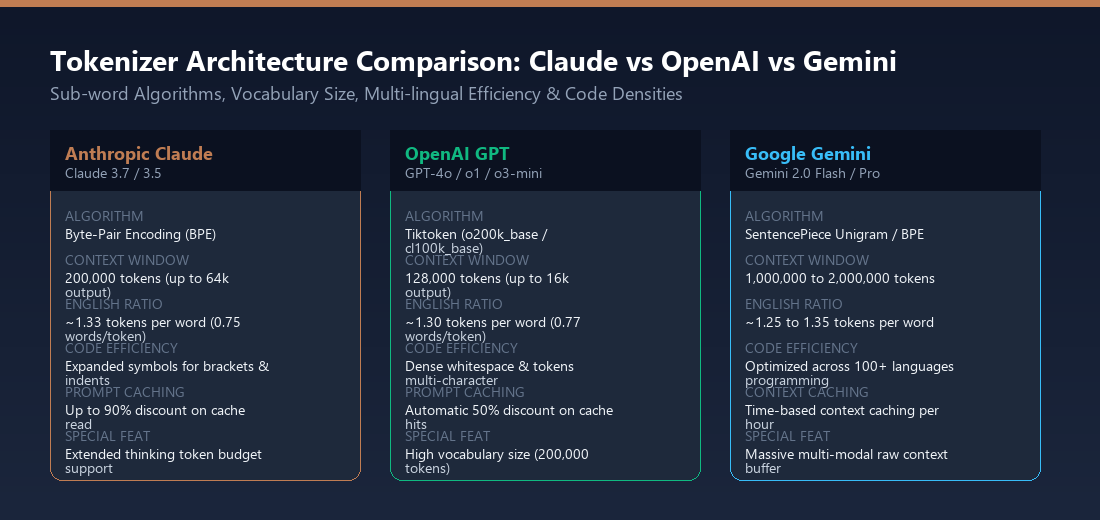
Claude vs OpenAI vs Gemini Tokenizer Architecture Comparison
Here is a side-by-side comparison of the industry's leading tokenization engines:
| Feature / Metric | Anthropic Claude Tokenizer | OpenAI Tiktoken (o200k_base) | Google Gemini Tokenizer |
|---|---|---|---|
| Core Algorithm | Byte-Pair Encoding (BPE) | Byte-Pair Encoding (BPE) | SentencePiece Unigram / BPE |
| Vocabulary Size | ~65,000 tokens | 200,000 tokens | ~256,000 tokens |
| English Efficiency | ~1.33 tokens / word | ~1.30 tokens / word | ~1.25 to 1.35 tokens / word |
| Code Whitespace | Multi-space compression | Explicit space tokens | SentencePiece character merges |
| Context Window | 200,000 tokens | 128,000 tokens | 1,000,000 to 2,000,000 tokens |
| Max Output Tokens | Up to 64,000 tokens (3.7) | Up to 16,384 tokens | Up to 8,192 tokens |
| Prompt Caching Model | Explicit ephemeral breakpoints (90% off) | Automatic prefix matching (50% off) | Time-based context caching |
| Non-Latin Languages | Moderate sub-word splitting | Highly optimized in o200k | High efficiency across Asian scripts |
Key Takeaways for Multi-Model Systems
- OpenAI to Claude Migration: When migrating prompts from GPT-4o to Claude 3.7 Sonnet, expect token counts to increase by approximately 2% to 5% on pure English text, and up to 10% on code with unusual syntax, due to OpenAI's larger 200,000-token vocabulary table.
- Gemini's Raw Window vs Claude's Output Depth: While Google Gemini offers massive raw context buffers (up to 2M tokens), Claude 3.7 Sonnet leads the industry in maximum output generation capacity (64,000 tokens in extended thinking vs 8,192 in Gemini), making Claude the preferred engine for generating complete software modules and books.
---
7. Frequently Asked Questions (FAQ)
What is a token in Anthropic Claude?
A token is the fundamental atomic unit of text that Claude's neural network processes. In English, a token can be as short as a single punctuation character or as long as a complete four-letter word. On average, 1 token corresponds to approximately 4 characters or 0.75 words.
How to count Claude tokens and AI tokens before sending an API request?
You can learn how to count claude tokens instantly using our blank" rel="noopener noreferrer" class="text-[#C07D53] font-bold underline hover:text-black transition-colors">Free Claude Token Counter Tool. This free browser-based AI token counter and Claude 3.7 Sonnet token counter estimates tokens(https://rajatupadhyay.in/tools/claude-token-counter/) completely in your web browser. Alternatively, developers can use the official \@anthropic-ai/sdk\ library in Python or TypeScript, which provides a client-side \client.beta.messages.counttokens()\ method.
What is the maximum context window for Claude 3.7 Sonnet?
Claude 3.7 Sonnet features a 200,000-token context window, allowing you to submit approximately 150,000 words in a single API call. It also supports up to 64,000 output tokens when operating in extended thinking mode.
How much can I save with Claude Prompt Caching?
Anthropic Prompt Caching slashes input costs by 90% on subsequent cache reads within a 5-minute time-to-live window. For Claude 3.7 Sonnet, cached prompt reads cost just $0.30 per million tokens compared to the standard $3.00 per million tokens.
Does the Claude Token Counter log my prompts or sensitive code?
No. Our Free Claude Token Counter operates 100% client-side inside your browser runtime. No text, uploaded files, or code snippets are ever transmitted across the network or stored on any server.
---
Final Thoughts: Start Auditing Your AI Context Today
In enterprise software engineering, guesswork leads to unexpected cloud expenses and degraded user experiences. By calibrating your prompts, monitoring context window headroom, and deploying Prompt Caching and Batch API pipelines, you can run state-of-the-art Claude 3.7 Sonnet workflows at a fraction of standard retail rates.
Bookmark our free utility today and make token auditing a standard step in your AI development lifecycle:
👉 Launch the Free Claude Token Counter & Context Calculator
`